Aquatic Bed
Areas of shallow permanent water that are dominated by plants that grow on or below the surface of the water.
Great Lakes Coastal Wetland
The hydrology of these wetlands is driven by Great Lakes water level fluctuations. There are different types of these rare wetlands due to substrate (clay, sand, muck) and exposure to wind and wave action.
Barrier-beach Wetland
A barrier beach wetland is formed when nearshore currents deposit a sand or gravel barrier bar across the mouth of an embayment. These wetlands form behind the sand barrier. The resulting shallow pond or lagoon is sheltered from the lake’s wave energy; sediments accumulate in the lagoon basin and vegetation can become rooted. Although water levels in the lagoon may be augmented by tributary streams and groundwater seepage, coastal lagoon wetlands are also partially controlled by the Great Lakes, through permanent or intermittent connecting channels, wave overwash, or cross-bar seepage.
Protected Embayment
Many stretches of bedrock or till derived shorelines form small protected bays, typically less than three or four kilometers in width. These bays can be completely vegetated with emergent or submergent vegetation. Examples include Duck Bay and Mackinac Bay in the Les Cheneaux Islands on Lake Huron, Matchedash Bay on Lake Huron, and Bayfield Bay on Wolfe Island in Lake Ontario.
Tombolo
An island connected to the mainland by a beach ridge or series of beach ridges. Enclosed lagoons can contain dense growth of aquatic vegetation, and there is occasionally a fringe of emergent vegetation outside of the tombolo.
Interdunal Swale Wetland
A wetland dominated by grass-like vegetation that occurs in the low areas between sand dunes or beach ridges along the Great Lakes shoreline. These wetlands depend on the Great Lakes for their water source. As such, their water table and period of saturation fluctuates with Great Lakes water levels. Because of the highly variable ecosystem characteristics, and the fact that they exist nowhere else on earth, interdunal swale wetland/upland complexes support many endangered or threatened species such as the Piping Plover, Pitcher’s thistle, Lake Huron tansy, and Houghton’s goldenrod. Due to a combination of the natural fragility of interdunal wetlands and the loss of shoreline habitat due to development along the Great Lakes shoreline, these habitats are threatened.
Marsh
A frequently or continually inundated wetland characterized by grass-like and other emergent vegetation adapted to saturated soil conditions. Typical marsh plants include rushes, reeds, sedges, cattails, and grasses. They are wet areas which can be periodically covered by standing or slow-moving water and are usually associated with ponds, rivers, streams, inland lakes, and the Great Lakes. Although some marshes have sandy soils, marshes usually have finer textured, nutrient rich soils with a high content of organic matter.
Peatlands
Peatlands occur as thick peat deposits in old lake basins or as blankets of peat across the landscape. Their formation is due to the combination of cool temperatures and adequate rainfall in northern temperate regions around the earth. Peat-accumulating wetlands include both bogs and fens.
Bog
Bogs form in lake basins that are isolated from sources of ground water. Because normal rainwater (the only water source for true bogs) is slightly acidic, bog water tends to be slightly acidic. The acidic nature of bogs supports acid-loving (acidophilic) vegetation, especially Sphagnum mosses, and contributes to a deficiency in available plant nutrients. As a result, many plants, animals, and microbes have special adaptations.
Fen
A peat-accumulating wetland that receives some inputs of groundwater or drainage from surrounding mineral soils which typically results in alkaline waters and usually supports grass-like vegetation.
Swamp
A wetland dominated by trees or shrubs. Swamps are usually inundated or saturated periodically at some point during the growing season. The soils in swamps are usually rich in nutrients and organic matter. This is due to silt and organic matter deposited by flood events and the accumulation of organic matter (dead trees and other vegetation) over time.
Vernal Pool
An ephemeral wetland usually in a forested area. Vernal pools are small isolated wetlands that only hold water for a short time during the spring. After snowmelt, amphibians congregate in vernal pools to create another generation of frogs, toads, and salamanders. By midsummer, the water is gone from this important, yet ephemeral, wetland.
Wet Meadow
Grassland with saturated soil near the surface but without standing water for most of the year. Wet meadows contain grass-like vegetation and saturated soils, but seldom have water standing on the ground surface. Many wet meadows occur in the former lakeplain of the Great Lakes, especially in southeast Michigan and the Saginaw Bay watershed. Because these areas are relics from a former geologic epoch, they provide habitat for many plant species rare in Michigan that are typically adapted to prairies. Unfortunately, a large percentage have been severely degraded or converted to agriculture or housing.
Wet Prairie
Wet prairies are intermediate areas between a marsh and a wet meadow. They once covered the flat lakeplains of Southern Michigan, but are not considered rare. They typically experience seasonal flooding and are among the most diverse plant communities in Michigan.
Wetlands are complex ecosystems that provide numerous benefits to society. Everyone benefits from the multitude of functions and values that Michigan’s wetlands provide. Wetlands provide critical wildlife habitat, prevent shoreline erosion, and protect water quality. They are the most biologically productive ecosystems in the Great Lakes watershed. These benefits become increasingly significant as we continue to lose wetlands throughout Michigan.
Fish and Wildlife Habitat
Wetlands are considered “nature’s nurseries” providing critical habitat for fish and wildlife.
Fish
Most freshwater fish are considered wetland dependent. Nearly all fish in the Great Lakes Basin directly rely on wetlands for some point in their life cycle. Fish feed in wetlands or on food produced there. Wetlands serve as nursery grounds for many species whose young take cover there, and many important sport fishes spawn in or near wetlands.
Birds
Like fish, many bird species are dependent on wetlands for either migratory resting places, breeding or feeding grounds, or cover from predators. It is estimated that more than one-third of all bird species in North America rely on wetlands for at least one of these purposes.
Amphibians
Nearly all of Michigan’s amphibians are wetland dependent, especially for breeding. Amphibians are sensitive to changes in wetland quality and quantity. Many scientists correlate declines in amphibian populations with wetland degradation worldwide.
Mammals
Wetlands serve as the preferred habitat for many mammals such as muskrat, beaver, otter, mink, and raccoon. In Northern Michigan, cedar swamps are critical to white-tailed deer for many reasons, including winter browse (northern white cedar sustains deer in the absence of other foods) and important thermal cover during harsh winters.
Threatened and Endangered Species Habitat
Wetland habitats are critical for the survival of threatened or endangered species. Endangered species are those that are in danger of becoming extinct. Threatened species are those that are in danger of becoming endangered. These species represent a unique element of Michigan’s valuable natural heritage. More than one-third of all threatened or endangered animal species in the United States live in wetland areas or depend on wetlands for some part of their life cycle. This is especially critical considering that wetlands comprise only about five percent of the lower 48 United States.
In Michigan, at least 41 listed threatened and endangered species of animals depend upon wetlands at some point in their life cycle. Examples of Michigan’s threatened or endangered animals that rely on wetlands include the bald eagle, osprey, common loon, and king rail. According to the Michigan Natural features inventory, of Michigan’s total 395 threatened, endangered, rare, and special concern plant species, 194 of them are found in wetland habitats. Thus, nearly 50% of Michigan’s plants of management concern reside in less than 15% percent of Michigan’s surface area.
Water Quality Protection
Wetlands act as “nature’s kidneys” by removing polluting nutrients and sediments from surface and groundwater. By protecting water quality, wetlands keep our lakes, streams, and groundwater healthy and are important to the integrity of aquatic ecosystems.
For example, the value of wetlands for maintaining water quality can easily be seen if we look at the problem of municipal water supply and treatment. On the delivery side of the water equation, clean water resulting from the water quality maintenance function of wetlands helps to keep water treatment costs low. Groundwater is vulnerable to contamination at many recharge areas. The filtering capacity of wetlands serve to protect vulnerable aquifers. On the treatment side of the water use equation, the pollution treatment functions of natural wetlands have been mimicked in artificial wetlands constructed to serve as wastewater treatment systems. As alternatives to typical engineered systems, created wetlands provide a cost-effective approach to meeting human needs.
Wetlands retain or remove nutrients in four ways: 1) uptake by plant life, 2) adsorption into sediments, 3) deposition of detritus (organic materials), and 4) chemical precipitation. The most significant of these is the uptake of nutrients by plants (which occurs primarily during the growing season, the same time that lakes and streams are most sensitive to nutrient inputs) and adsorption into sediments.
Excess nutrients can cause an undesirable increase in algae and aquatic plant growth. The result is water that is reminiscent of pea soup, weed-choked lakes, depleted dissolved oxygen levels, and the rapid aging or “eutrophication” of a lake. This in turn impacts other functions such as use for recreation and fish and wildlife habitat.
In the Great Lakes Region, the massive algae blooms and depleted dissolved oxygen levels of Lake Erie in the early 1970s is a classic example of what happens to an aquatic system under the strain of too many nutrients.
Sediment Control
As sediment-laden water flows through a wetland from the surrounding watershed, the sediments are deposited or trapped in the wetland. This reduces siltation into lakes, rivers, and streams.
There is a strong tendency for heavy metals and other toxic chemicals to attach to the sediment particles found in surface water runoff. Wetlands can trap these human-induced pollutants and remove them from the water column. However, when the natural ability of a wetland to function as a filter is overstressed from human inputs, the wetland and its functions can be destroyed. In fact, when overloaded, wetlands can actually become sources of pollutants, exporting materials that have been filtered and stored for centuries.
Protection of Shorelines and Erosion Control
In their natural condition, wetlands associated with rivers and lakes function as a barrier to erosion. The root systems of wetland plants stabilize soil at the water’s edge and enhance soil accumulation at the shoreline. Wetland vegetation along shorelines reduces erosion by dampening wave action and slowing the speed of water currents. When wetland and shoreline vegetation is removed, efforts to control erosion and sedimentation can be expensive and usually result in further degradation of fish and wildlife habitat. Maintaining or restoring wetland vegetation at the shore can be a cost-effective means of protecting the property from erosion and protecting the lake or stream from sedimentation.
Water Supply
Wetlands replenish groundwater supplies and their filtering capacity can also help protect groundwater quality. Wetlands are usually found where the groundwater table intersects or is close to the land surface. They are usually sites of springs or seeps where groundwater is discharged (places where groundwater seeps or flows to the earth’s surface) and are very important for providing high quality water for our lakes and streams. On the other hand, some wetlands are found where water moves into the groundwater system and recharges aquifers providing a source of clean drinking water. Because wetlands store water and slowly release it, they are also very important for maintaining base flow in streams.
Flood Storage and Conveyance
Wetlands act as sponges, temporarily storing flood waters and releasing them slowly, thus reducing flood peaks and protecting downstream property owners from flood damage. Wetlands and adjacent floodplains often form natural floodways that convey flood waters from upland to downstream points. These functions become increasingly important in urban areas where development has increased the rate and volume of stormwater runoff. Each year, many communities that have suffered extensive wetland loss experience severe flooding.
Food and Fiber Production
Wetlands support many commercial activities. Wetlands provide a variety of natural products including blueberries, cranberries, and wild rice. Wetland grasses are hayed in many places for winter livestock feed. Forested wetlands, such as cedar swamps, can provide sustained yields of valuable timber if harvested with careful management and planning. It must be noted that many commercial activities, such as peat mining, logging, livestock grazing, or cranberry cultivation can severely degrade wetlands and a majority of their values if not conducted on a small scale with the utmost of care.
Recreational Opportunities and Hunting, Fishing, and Trapping
Wildlife-related recreation is a $22 billion industry in the Great Lakes states. Bird watching is quickly becoming a popular pastime and wetland-rich communities, such as the Les Cheneux area in Michigan’s Upper Peninsula, are beginning to realize the economic benefits of promoting this activity. Rare, threatened, and endangered plant and animal species provide added interest for naturalists.
According to the American Sportfishing Association, more than 35 billion dollars is spent annually by an estimated 50 million people on fishing. These expenditures generate over one trillion dollars of economic output. In Michigan alone, anglers spend more than $1.5 billion on their sport and generate nearly $3 billion in total economic output. Hunting and trapping also generate significant economic output, especially in rural areas of the state.
Since nearly all sport fishes, many popular game animals, and most fur-bearing animals depend on wetlands for their survival, healthy and functioning wetland ecosystems are necessary to maintain the resource base for this segment of the economy.
Historic and Archeological Values
Some wetlands are important for historic, archeological, or paleontological reasons. Because wetlands served as a good source of food, early Native American settlements were often located in or near wetlands. Well-preserved remains of prehistoric mammals and Native American artifacts have been found in Michigan’s wetlands. Bogs, due to the extremely slow rate of decomposition resulting mainly from anaerobic conditions and their acidic nature, were used by pre-historic residents of Michigan to store meat- mastodon meat!
Education and Research
Wetlands serve as wonderful outdoor classrooms, providing excellent opportunities for discovery and living examples of nearly all ecological principles. Boardwalks and observation platforms have been constructed in many wetlands across the state to facilitate educational activities.
Aesthetic Values
The richness of the plant and animal communities found in wetlands make them some of Michigan’s most beautiful natural environments. Wetlands provide valuable open space for visual and recreational enjoyment. Throughout the state, protected wetlands have been shown to enhance the value of neighboring properties due to these factors. Perhaps the most valued function of wetlands is the space they provide for introspection, quiet reflection, and the opportunity to experience wildness.
Coastal Wetlands and Great Lakes Shoreline Management
During low water periods such as we have right now, nearshore areas of the Great Lakes that are typically under water are exposed. These exposed bottomlands naturally become vegetated and form coastal wetlands. This natural increase in vegetation growth during low water periods is vital to the overall health of the Great Lakes ecosystem. Coastal wetlands provide a range of important functions including critical habitat for fish and wildlife, erosion control, water quality protection, and a myriad of recreational opportunities. Coastal wetland systems support diverse assemblages of invertebrates, fish, reptiles, amphibians, birds, and mammals. In particular, over 90% of the roughly 200 fish species that occur in the Great Lakes are dependent upon coastal wetlands for some part of their life cycle.
The Rapanos Decision
In one of the most important clean water cases in decades, the United States Supreme Court issued a fractured decision on the reach of the federal Clean Water Act in June 2006. The 5-4 decision further confused federal protection of wetlands throughout the country.
The Supreme Court case combined two cases, United States v. Rapanos and Carabell v. United States, involving Michigan wetlands and streams. The combined case addressed whether the Clean Water Act protects wetlands adjacent to small tributaries that flow into larger water bodies.
Wetland Loss
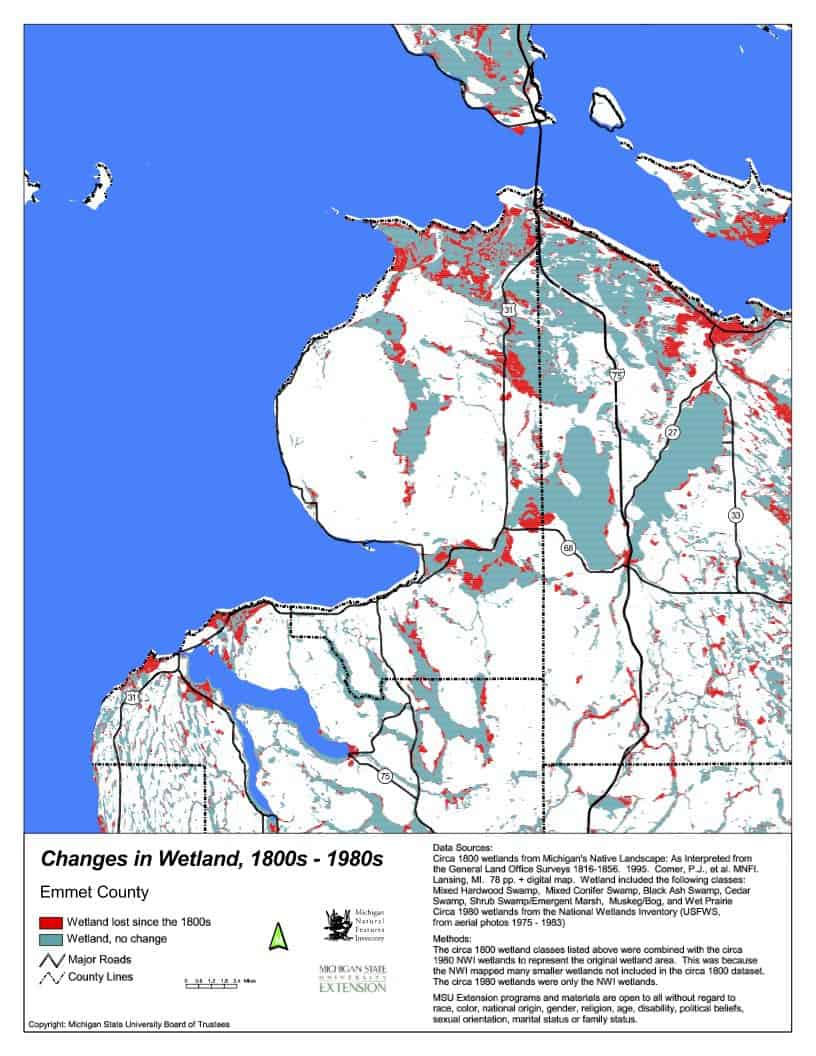
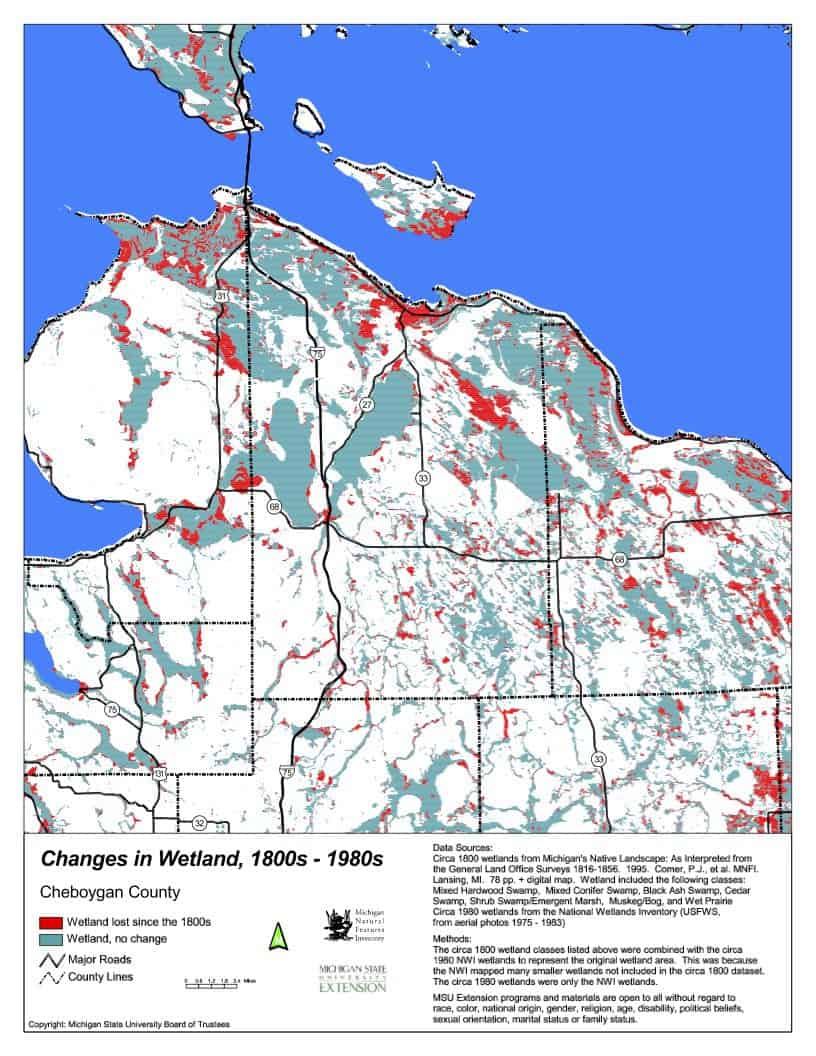
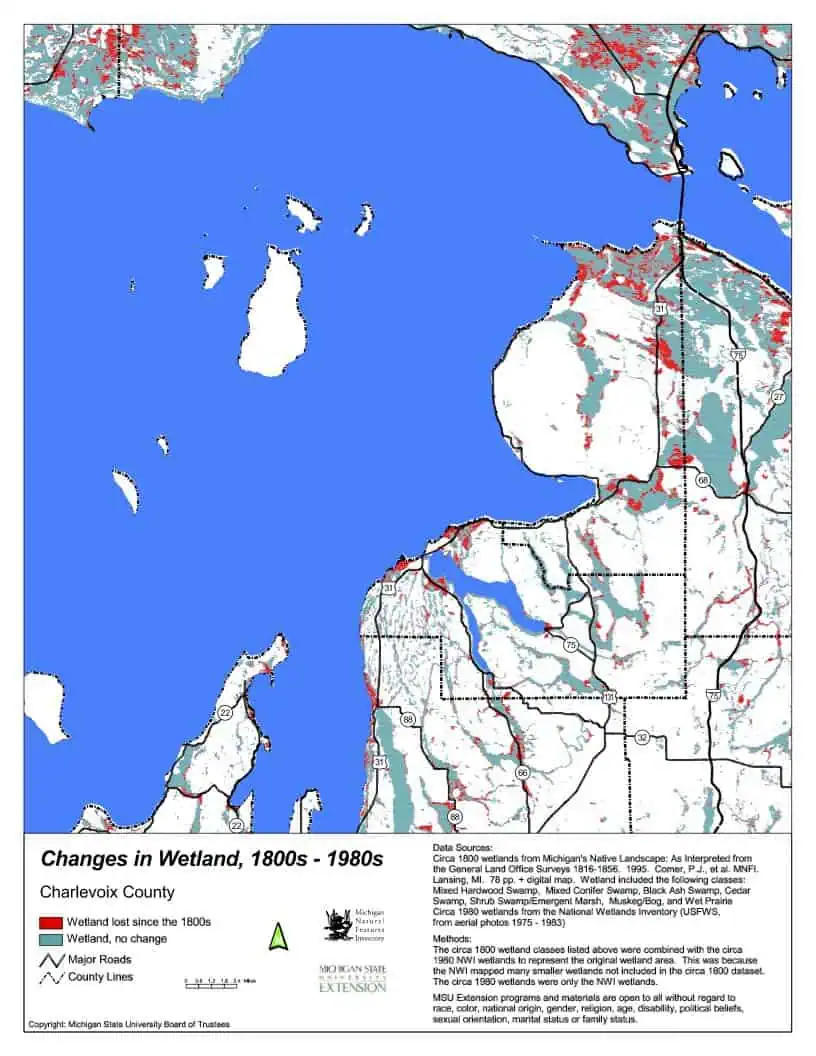
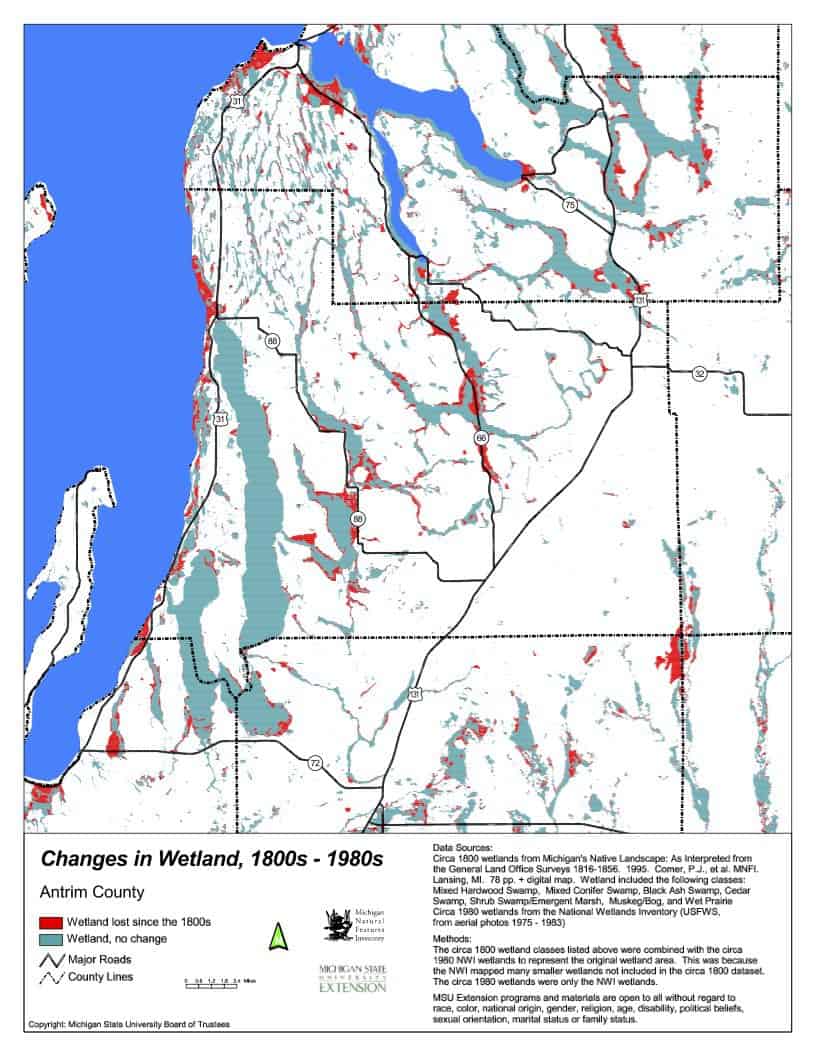
Although the benefits that wetlands provide make them some of our most valuable landforms, the United States and Michigan have lost alarming amounts of wetlands.
The United States was at one time blessed with an abundance of 225 million acres of wetlands. Since European settlement, the lower 48 United States have lost over 53% of their original wetlands. The lower 48 states contained an estimated 105.5 million acres of wetlands in 1997. Great Lakes states and the province of Ontario have fared worse – it’s estimated that only 30% of the original wetlands remain in the Great Lakes Basin. In the most recent survey conducted by the U.S. Fish and Wildlife Service, Michigan has lost 50% of its original wetlands. The percentage of Michigan’s coastal wetlands that have been lost is even greater–70%. In total over 5,600,000 acres of wetlands have been damaged or destroyed in Michigan.
Our realization of wetland values is relatively new. Wetlands were formerly thought of as areas of pestilence that needed be dredged, drained, or otherwise converted to higher use. In association with the need for humanity to manipulate and overcome wetlands, there has also been a societal perception that wetlands were undesirable, dangerous places. As a result, millions of dollars of public funds have been spent in destroying wetlands throughout our history. George Washington took it upon himself to drain the Great Dismal Swamp in hopes of using the land for farming and thought of himself as a failure because he was not successful in accomplishing this task. The portrayal of wetlands as dark and mysterious places where we might get lost and where danger lurks was further engraved into our society by Hollywood with movies such as the “Creature from the Black Lagoon” and “Swamp Thing.”
Without the dramatic flair of Hollywood, wetlands are still seen as breeding grounds for mosquitoes; some take the claim even further with wetlands serving as the breeding grounds for mosquitoes that are carrying the West Nile virus. Even our language has been shaped by this cultural history and societal perception of wetlands; “bogged down,” “mired,” “swamped,” all have negative connotations. For hundreds of years, wetlands have been seen as wastelands, only useful if converted. Due to this belief and negative perception, wetlands across the country have disappeared. See Wetland Changes section below.
No copy on live site to transfer
Part 303 requires a wetland construction permit application to be submitted, and a permit obtained, prior to undertaking any regulated activity (e.g., dredging, draining, filling, maintained use or development, etc.) within regulated wetlands. Part 303 does require the applicant to properly identify the location of wetlands that may be impacted and verify that the applicant has taken steps to avoid or minimize any impacts to wetlands. There are three types of permits:
Since Section 404 permitting is administered by the Michigan Department of Environment, Great Lakes, and Energy (EGLE), for most projects, only the ELGE permit is needed. A federal permit from the U.S. Army Corps of Engineers (USACE) is only required for work proposed in Section 10 navigable waters of the United States. This is in addition to the EGLE permit. The Army Corps and EGLE use a joint application form (which is delivered to EGLE) and may issue a Joint Public Notice, but separate permit actions are taken by the two agencies. You need to receive a permit from both agencies prior to starting any work.
Pre- Application meetings are offered by EGLE to review a proposed project prior to submittal of a full application in order to facilitate preparation of an acceptable proposal and expedite permit processing. A pre-application meeting can be conducted at a district office or at the site of the proposed project. EGLE Pre-Application Meeting Webpage
MiWaters – Water Resource Information and Forms
This site allows the permit applicant, or any member of the general public, to search for permits or permit applications by geographic area, or to check on the status of a pending application. Public notices are also posted on-line, and comments may be transmitted electronically directly to the permit reviewer.
Wetland determination (sometimes called identification) is simply the determination of whether an area is a wetland or not. Wetland delineation is the actual determination and establishment of wetland boundaries.
Delineations are based on the definition of wetland in the Clean Water Act.
From the definition, there are three criteria to delineate wetlands: wetland hydrology, hydric soils, and hydrophytic vegetation.
Hydrology
Wetland hydrology refers to the specific hydrologic conditions that are required to form and maintain wetlands. Saturation at or near the surface, or inundation, for approximately 14 consecutive days or more during Michigan’s growing season typically creates the necessary conditions in the soil to form and maintain wetlands. Wetland hydrology, hydric soils, and hydrophytic vegetation are all linked. Hydrophytic vegetation and hydric soils result from wetland hydrology; and conversely, the presence of hydrophytic vegetation and hydric soils indicate wetland hydrology.
Of the indicators used for wetland identification, wetland hydrology is the most variable and often the most difficult to observe directly. Numerous factors influence hydrology, including precipitation, topography, soil permeability, and plant cover. The technical wetland hydrology criteria looks at the distance to the water table based on soil drainage and permeability characteristics.
Common Field Indicators of Wetland Hydrology
Hydric Soils
Hydric soils have physical and chemical indicators of repeated and prolonged saturation at or near the soil surface. These indicators are a direct result of the lack of oxygen in the upper part of the soil caused by the presence of water in the spaces between soil particles (which forces air out of the soil). In Michigan and most of the temperate regions of the United States, hydric soils are flooded, ponded, or saturated for about 14 consecutive days during the growing season.
Common Field Indicators of Hydric Soils
Hydrophytic Vegetation
Hydrophytic (water-loving) vegetation is plant life that is adapted to grow in areas where the frequency and duration of inundation or saturation is sufficient to exert a controlling influence over the plant species present. Among other things, all plants need oxygen and water. There is a point at which the frequency and duration of water in the soil causes at least periodic deficiencies in oxygen in the root zone. This is because water replaces air in the spaces between the soil particles in saturated conditions. In order to survive the stress of low oxygen levels in the root zone, hydrophytic plants have structural and functional adaptations to allow them to thrive in these areas.
The U.S. Fish and Wildlife Service, in cooperation with other agencies and professional botanists, developed the following categories to help determine if a vegetation community would be considered to be adapted to wetland conditions:
Facultative Upland Plants (FACU) — Species in this category are estimated to occur in wetlands approximately 33-1 percent of the time.
Obligate Upland Plants (UPL) — Species in this category are estimated to occur in wetlands less than 1 percent of the time.
Wetland Identification Program
The Michigan Department of Environment, Great Lakes, and Energy (EGLE) has a Wetland Identification Program (WIP) to assist the public in identifying wetland and non-wetland (i.e., upland) areas on their property. The WIP offers levels of service to assist the public.
Level 1: Wetland Inventory Maps
EGLE wetland inventory maps are now available for each county are available in electronic form, or can be requested in paper form at cost, on the ELGE website under Wetland Inventory Maps. Since these maps are not based upon an on-site review, the EGLE does not provide a jurisdictional guarantee or a map specific to the parcel.
Level 2: On-Site Determination
This service offers an on-site review of an identified area, up to five acres in size, by EGLE staff. The ELGE staff will identify, with flagging, areas that contain wetland and determine whether the wetland is regulated under Part 303. The purpose of this type of review is to identify areas where permits are not required.
Level 3: On-Site Wetland Boundary Confirmation
This service offers an on-site review of an identified area by EGLE staff to verify a wetland delineation (i.e, identification of a specific wetland boundary) completed by a wetland professional and/or consultant. The EGLE staff will verify flagged wetland boundaries placed by the applicant’s wetland consultant and whether the wetland is regulated under Part 303.
Click here for more information on the Wetland Identification Program.
Wetland Science & Mapping
Michigan Wetland Inventory
Michigan Natural Features Inventory
National Wetlands Inventory
Great Lakes Coastal Wetlands Consortium
Permit Tracking
MiWaters – Water Resource Information and Forms
US Army Corps of Engineers Detroit District Public Notices
Regulatory Agencies
Michigan Department of Environmental Quality Wetlands Protection Page
U.S. Army Corps of Engineers Detroit District Regulatory Page
MDEQ/USACE Joint Permit Application
Wetland Links
Environment Canada Great Lakes Coastal Wetlands Page
MDEQ Wetlands Protection Page
EPA Wetlands Page
Michigan Sea Grant Wetlands Page
Great Lakes Information Network Wetlands Page
Society of Wetland Scientists North Central Chapter
Association of State Wetland Managers
The Michigan Wetland Association
National Wetlands Plant List Webpage
The Ramsar Convention on Wetlands
MDEQ Consultant List
(This is not a recommendation on any consultant. We make no endorsement or representation of any qualifications or lack of qualifications by any of the individuals or companies listed.)
 | Little Traverse Conservancy Properties:
Click here for more information about the Little Traverse Conservancy Nature Preserves. |
 | Walloon Lake Trust and Conservancy Properties
Click here for a more information about the Walloon Lake Trust and Conservancy Preserves. |
The purpose of this application is to provide the public with quick and easy access to wetland spatial data and you can find wetland map data through a text search or map search. To find wetlands on public accessible lands, go to map search and click on layers. Turn on the wetland inventory and “conservation and recreational lands” layers.